
Produced in Squamish, British Columbia by Wayne Stevenson, our eleventh visual release trades instrumental solitude for a raw, late-1970s soul duet about dropping your shield before somebody you love walks out the door.
Don’t Say You’re Fine began with an image almost every adult recognizes but nobody likes admitting out loud: two coffee cups sitting cold in the sink while somebody you love folds their coat by the hallway door. You ask what is wrong, they stare at the floorboards, and they offer the most dangerous two-word truce in any marriage or long partnership. They tell you nothing is wrong right as their hand reaches for the brass latch.
When I sat down in my Squamish studio to produce the opening title track of our new ten-song album, Don’t Say You’re Fine, I wanted zero modern studio camouflage. After releasing ten straight instrumental records built for heavy concentration, I needed a vocal record with real scars on its knuckles—a weathered male baritone answering a smoky velvet alto across four minutes of vintage Wurlitzer chords, brushed snare rimshots, bowed cello, and candlelit midnight cinema.
Table of Contents

1. Why I Produced Don’t Say You’re Fine After Ten Instrumental Chapters
If you spend your daylight hours running job sites, reviewing structural drawings, or carrying the weight of a company on your back, composure becomes muscle memory. You train yourself never to flinch when a schedule slips or a load calculation pushes back. That armor keeps projects standing during business hours, yet it becomes quietly destructive the second you carry it across your own threshold after dark and forget how to take it off.
Look back across the first ten releases in our Keystone Recomposition Sonic Universe—records like Heavy Civil Focus and Peak Intensity—and you hear the sound of discipline in motion. Those chapters were built for momentum, iron, and solitary execution. By the time we reached Day 11, though, I wanted to turn the microphone toward what happens after the boots come off and the house goes dead quiet.
Don’t Say You’re Fine lives inside that exact two-in-the-morning standoff where pride and exhaustion collide. In the opening verse, the male baritone watches a coat being folded and sees every unspoken hurt worn right out on a sleeve, yet neither person wants to blink first. Anyone who has built a life alongside another strong-willed human knows how fast a ten-foot kitchen can start feeling like an empty field.
What breaks the stalemate in the second verse is not a grand speech; it is a tiny crack in a voice when one partner says the other’s name. When the female alto answers—admitting she stayed quiet only to avoid starting another 2 AM war after forgetting what they were even fighting for—the song stops keeping score. Both people realize their shields are protecting nothing worth keeping.
Every time I play back the chorus of Don’t Say You’re Fine, one line still hits me square in the ribs: “Come back across the kitchen floor / I don’t wanna win if it costs us more.” Winning an argument against the person you love is the most expensive loss a builder can ever take, and putting that truth on wax felt overdue.
2. Vintage Wurlitzer, Bowed Cello & The 65.2 BPM C-Minor Pocket
Great late-seventies soul records never rush a confession, and we refused to rush Don’t Say You’re Fine. Written in the nocturnal key of C Minor, the arrangement settles into a measured 65.2 BPM half-time pocket where the brushed snare rimshot leans slightly behind the pulse. That unhurried space lets every chord decay naturally into the walnut room before the next vocal phrase steps forward.
From the eight-second intro, a warm vintage Wurlitzer electric piano lays down minor-ninth voicings anchored by a round, finger-plucked Motown bass guitar. We deliberately banned surgical pitch correction, quantized plastic drums, and brittle high-frequency sheen from the mix bus. When a gravelly soul baritone confesses he has been distant and trapped inside his own head, sanding away the grain in his throat ruins the entire point.
Listen closely at the forty-seven-second mark when the smoky female alto enters for Verse 2, and you will hear a single bowed cello sustain underneath her lower register. That woody low-mid warmth acts like a second heartbeat under the lyric right until both singers lock into two-part harmony on the pre-chorus plea: “Put the suitcase down for a minute / If this love still has us in it.”
When the first full chorus opens up at 1:31, live brass swells and orchestral violin lines lift the duet without ever crowding the center vocal pocket. Across the 242.44-second studio WAV master, our ten-second root-mean-square energy envelope climbs organically from an intimate 0.0758 opening whisper to 0.1373 on the first hook, preserving real analog breathing room instead of brick-walling every bar to the same flat ceiling.
Inside DaVinci Resolve Studio, we conformed the final 4K visual directly against that uncompressed 24-bit / 48,000 Hz stereo master at 0.0 dB unity gain. Zero generated clip noise bleeds into the soundtrack, and zero secondary broadcast limiters flatten the brass transients when Don’t Say You’re Fine surges into its final third-minute climax.
3. Studio Master & Duet Architecture Table (ISRC QTA9R2619963)
Every recording in our catalog carries verifiable international rights metadata, lossless archival masters, and transparent production specs so collectors, playlists, and licensing supervisors know exactly how the work was built. Here is the complete studio and visual dossier for Don’t Say You’re Fine across our Official Artist Channel and global streaming partners:
| Studio / Film Dimension | Verified Specification | Production Note |
|---|---|---|
| Release & Producer | Don’t Say You’re Fine — Wayne Stevenson (Keystone Recomposition) | Day 11 (RECOMP_011) • Track 01 Lead Single |
| Parent Album & Catalog | Don’t Say You’re Fine (10-Track LP • Released Oct 26, 2026) | Too Lost ID #1939363 • TOOLOST31792387094495902 |
| ISRC & Album UPC | ISRC: QTA9R2619963 • UPC: 0641360960445 | MusicBrainz & Global DSP Registered |
| Genre, Key & Feel | 1970s Soul Revival & Late-Night R&B Duet • C Minor • 65.2 BPM | Laid-Back Half-Time Soul Pocket |
| Vocal & Live Ensemble | Gravelly Male Baritone & Velvet Female Alto Call-and-Response | Wurlitzer, Rhodes, Motown Bass, Bowed Cello & Brass |
| Master WAV & RMS Arc | 24-Bit / 48 kHz 0.0 dB WAV • 242.44s (4m 02s) Runtime | 0.0758 Intro → 0.1783 Climax → 0.0044 Fade |
| Set Architecture | Mid-Century Walnut & Velvet Soul Lounge Overlooking Rainy Harbor | Limestone Bar, Vinyl Credenza, Grand Piano & Stone Hearth |
| Wardrobe & 4K Delivery | Champagne-Espresso Draped Silk Satin Gown & 24K Gold Drop Earrings | 3840×2160 24fps H.265 • 25 Continuous 10s Shots |
4. Four Acts in the Candlelit Lounge: Directing Don’t Say You’re Fine
When we began storyboarding the four-minute visual for Don’t Say You’re Fine, the easiest cliché on earth would have been filming two actors arguing across a kitchen counter and mouthing every lyric at each other. I threw that idea out immediately. Watching performers mime heartbreak on camera makes an audience judge the acting; watching a composed person hold everything inside while a duet plays like her private memory makes you feel it.
Instead, we built a midnight sanctuary out of dark mid-century walnut paneling, tufted velvet booths, warm amber brass table lamps, and floor-to-ceiling glass overlooking a rain-speckled city bay. Our protagonist steps into that room wearing a draped champagne-gold and espresso-brown silk satin evening gown with delicate 24K gold drop earrings, carrying the exact dignified stillness people project when they refuse to admit their heart is shaking.
Act I (0:00–0:50) — Unspoken Distance Across the Table: As the opening Wurlitzer chords establish a quiet 0.0758 RMS pulse, the camera glides slowly toward the candlelit limestone bar. She walks unhurriedly past empty cocktail tables and along the velvet booth corridor, casting one composed over-the-shoulder glance toward an upright double bass and vintage grand piano resting in soft tungsten bokeh while the first verse lays out the stalemate.
Act II (0:50–1:50) — Brushed Snare & Vintage Rhodes Confession: Right as the smoky alto voice and bowed cello enter the mix, a side-profile tracking move follows her past a spinning vinyl turntable on a walnut credenza. At 1:05 her fingertips rest lightly beside an untouched crystal glass of amber reserve—a small, human hesitation—before a sweeping crane drift follows her toward the rain-streaked harbor window as the first chorus breaks at 0.1373 RMS.
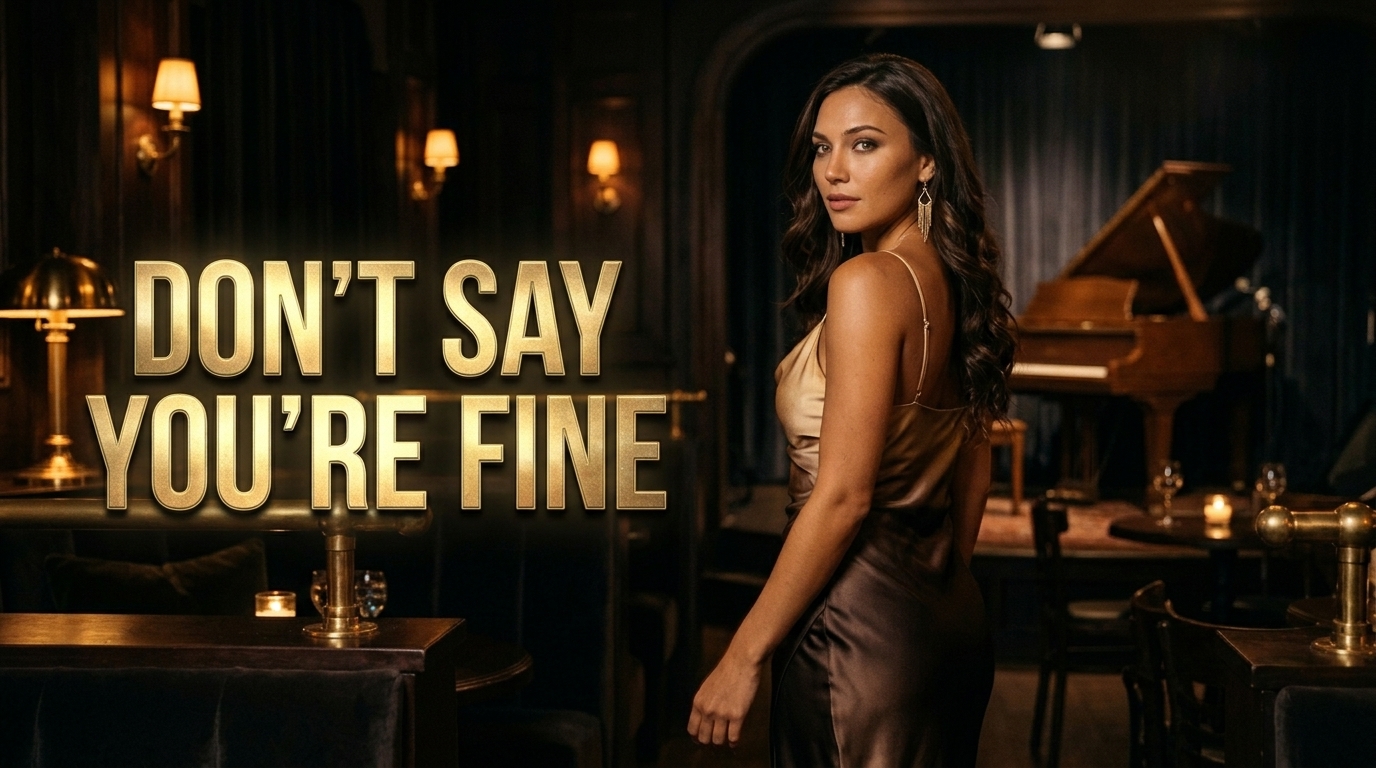
Act III (1:50–2:50) — Velvet Stage Swell: Halfway through Don’t Say You’re Fine, the male and female singers trade their most disarming lines in Verse 3: “We don’t need perfection, we just need the truth / Like we had back when we had nothing to lose.” Visually, the camera answers that honesty with a full 360-degree orbit in the center of the walnut room and catches her satin silhouette reflected inside the dark mirror-polished lid of the grand piano.
Act IV (2:50–4:02) — The Gospel-Soul Reckoning & Hearth Resolution: At 2:50 she turns quietly toward a private stone fireplace alcove just as the band drops away to bare electric piano and weeping cello. When both voices cry “Let the armor fall” and surge into the final chorus belt—peaking at 0.1783 RMS between 3:20 and 3:30—amber hearth firelight meets midnight-blue window rim light across her profile before soft muted trumpet eases the final wide pullback to 0.0044 silence.
Across all twenty-five continuous ten-second shots in Don’t Say You’re Fine, we used zero cutaway B-roll, zero visual gimmicks, and zero lip movement. Restraint does the heavy lifting, letting warm 35mm grain, brass lamp reflections, and unhurried body language mirror every swell of the rhythm section.
5. The 2:50 Gospel-Soul Reckoning & Our 40-Second Vertical Film
Most short-form music teasers grab the opening ten seconds of a song and wonder why mobile listeners swipe past before anything happens. When we cut the forty-second vertical companion visual for Don’t Say You’re Fine, we went straight to the emotional hinge of the master WAV at 170.0 seconds—the exact bridge transition between 2:50 and 3:30 where pride finally cracks wide open.
Framed natively in 9:16 vertical cinema rather than clumsily cropped from widescreen, four sequential ten-second movements carry the viewer from the candlelit limestone bar past the spinning vinyl credenza into a vertical 360-degree tungsten chorus orbit, finishing with a crane pullback past the grand piano toward the rainy midnight bay. Watch the companion Short below, or catch it streaming natively on TikTok (@keystone.recompos), Instagram Reels, and Facebook Reels:
Starting right as the female alto whispers “Let the armor fall” and the male baritone answers “I don’t need it at all” gives mobile listeners the full dynamic contrast of Don’t Say You’re Fine in forty seconds flat. One tap on the Related Video bridge inside YouTube Shorts brings newcomers straight into the four-minute widescreen lounge experience.
6. Ten Midnight Stories: Where the Album Goes After Track One
Don’t Say You’re Fine is not a standalone single tossed into an algorithm; it is the front door to a complete ten-track 1970s soul revival LP distributed worldwide under UPC 0641360960445 via our official TooLost album hub. I sequenced all ten duets like scenes from one long weekend between two people deciding their history is worth fighting to keep.
Right after the kitchen-floor truce of Track 01 fades out on muted trumpet, Track 02—Velvet on the Dashboard (ISRC QTAB42778904)—pulls off a rain-soaked highway onto a dark riverside shoulder over tremolo Fender Rhodes chords. By Track 03, Two Spoons in the Coffee (ISRC QTAB42701084), Friday night’s storm gives way to a warm Bb-Major Sunday morning kitchen pocket with Hammond B3 organ swell and Stax-inspired horns.
From there, the LP travels through winter lakefront tension in Slow Burn in Chicago (Track 04), dusty basement nostalgia spinning at thirty-three RPM on Secondhand Vinyl (Track 05), and the bare C-Minor torch balladry of Half Past Apology (Track 06). Closing chapters—Suitcase by the Doorway, Gold Ring on the Nightstand, Red Light on the Boulevard, and Last Call at the Mercy Lounge—complete an album built to be played front to back.
If I can offer one producer’s suggestion before you queue up Don’t Say You’re Fine tonight: skip the tiny phone speaker on your first listen. Wait until the house settles down, dim the overhead lights, pour whatever helps you unwind, and play the 24-bit stream through warm open-back headphones or living-room monitors where you can feel the bass guitar and cello sit right in your chest.
7. Studio Notes & Listener Questions on Don’t Say You’re Fine
Who sings and produces Don’t Say You’re Fine, and where is the master registered?
Don’t Say You’re Fine was executive-produced and arranged in Squamish, British Columbia by Wayne Stevenson under Keystone Recomposition Records. Styled as a classic male-baritone and female-alto soul duet, the master recording is registered globally under ISRC QTA9R2619963 as Track 01 of the ten-song album Don’t Say You’re Fine (UPC 0641360960445, Too Lost Release #1939363).
Why does the studio telemetry list 65.2 BPM for a 1970s soul duet in C Minor?
While classic soul rhythm sections carry an internal sixteenth-note pulse around double time, our acoustic transient analyzer locks onto the deep 65.2 BPM half-time backbeat where the Motown bass fundamental and brushed snare rimshot anchor the room. That slow, breathing cadence gives both vocalists space to phrase conversationally without ever rushing an emotional turn.
Why does the female protagonist in the 4K film never sing or lip-sync on camera?
Every visual on the Keystone Recomposition Official Artist Channel follows a strict non-verbal cinema discipline. Staging Don’t Say You’re Fine inside a rain-lit walnut and velvet lounge without lip-sync melodrama turns the duet into an interior monologue, allowing subtle eye contact, posture, and hearth firelight to carry the emotional weight honestly.
Where can I stream the lossless 24-bit album and watch the full 4K video?
You can watch the uncompressed 4K H.265 visual right at the top of this page or on YouTube (@KeyStoneRecomposition), and stream the 24-bit / 48 kHz studio master of Don’t Say You’re Fine across Spotify, Apple Music, Amazon Music, and our TooLost smartlink.
Track 01 of the 10-track LP Don’t Say You’re Fine (UPC 0641360960445) • Produced by Wayne Stevenson in Squamish, BC.
© 2026 Wayne Stevenson / Keystone Recomposition Records (Squamish, British Columbia, Canada). Master sound recording Don’t Say You’re Fine (ISRC: QTA9R2619963) and parent 10-track LP Don’t Say You’re Fine (UPC: 0641360960445, Catalog: TOOLOST31792387094495902) are original copyright-verified works distributed globally through Too Lost Digital. All 4K visual sequences are original non-verbal cinema productions created exclusively for the Keystone Recomposition Official Artist Channel.
Watch our 4K music video (youtu.be/BCVBlNO0p80) and vertical companion Short (youtube.com/shorts/m-6efjAobWU).

Wayne Stevenson
Wayne Stevenson — Licensed BC Builder #52603, Electronic Music Producer & Autonomous AI Systems Architect
Evidence-based systems, functional sonic architecture, and autonomous multi-agent engineering for high-performance fitness, longevity, and mountain lifestyle design.