
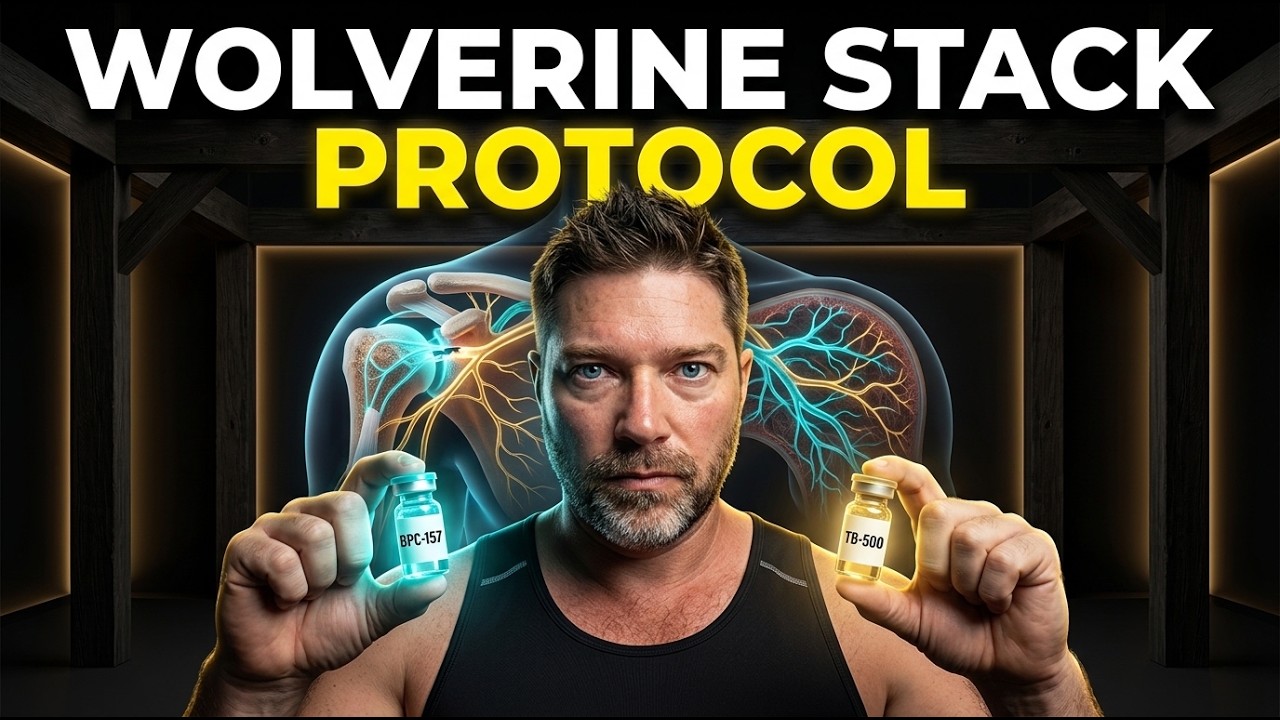
Day 17: BPC-157 & TB-500 Wolverine Stack — The Tendon Repair Protocol at 232 LBS
When an acute rotator cuff blowout tore my supraspinatus at 232 lbs on an active framing job site, conventional medicine offered a single catastrophic recommendation: immobilize the joint in a sling for six months. In Day 17 of the 258 to 210 lb transformation blueprint, licensed builder Wayne Stevenson (#52603) documents his authentic N=1 case study deploying the BPC-157 & TB-500 Wolverine Stack. Discover how pairing microvascular angiogenesis with actin-driven tenocyte motility reconstructed high-tensile structural collagen without brittle scar adhesions.
Explore Wayne’s documented recovery in the Day 16 Rotator Cuff Blowout Protocol and visit our complete Keystone Protocols Knowledge Hub.

- 1. The Wolverine Stack Synergy: BPC-157 & TB-500 Explained
- 2. Codman’s Critical Zone & BPC-157 VEGFR2 Angiogenesis
- 3. FAK & Paxillin Phosphorylation: Awakening Dormant Tenocytes
- 4. TB-500 / Thymosin Beta-4: The Cellular Transport Crane Fleet
- 5. Preventing Brittle Scar Adhesions & Frozen Shoulder (TGF-beta1 Suppression)
- 6. Bacteriostatic Water Reconstitution & Syringe Care
- 7. Wayne’s Personal N=1 Dosing Schedule & Systemic Administration
- 8. Verified Peer-Reviewed Clinical Citations (PubMed References)
1. The Wolverine Stack Synergy: BPC-157 & TB-500 Explained
Tendon tissue is naturally avascular. While skeletal muscle is saturated with dense capillary loops receiving abundant oxygen and nutrients, the distal supraspinatus tendon operates on less than one-seventh the vascular perfusion. When high-load mechanical shear tears avascular collagen, the body’s intrinsic repair signals stall.
In high-performance sports medicine, the combination of BPC-157 and TB-500 is designated the Wolverine Stack because it unites two completely distinct, synergistic biological mechanisms:
- BPC-157 (Pentadecapeptide 157): Acts as the specialized civil engineering trenching crew. It drives targeted microvascular angiogenesis, sprouting new capillary blood vessels directly into avascular dead zones.
- TB-500 (Thymosin Beta-4 Active Hexapeptide): Acts as the heavy mobile transport fleet. As the body’s primary G-actin sequestering peptide, it remodels the cellular cytoskeleton, propelling repair tenocytes across the defect while enzymatically preventing rigid scar adhesions.
⚡ BIOMECHANICAL MATRIX: MONOTHERAPY VS. THE WOLVERINE STACK
| Healing Parameter | BPC-157 Alone | TB-500 Alone | Wolverine Stack (Combined) |
|---|---|---|---|
| Microvascular Angiogenesis | High (VEGFR2 Activation) | Moderate (Tube Formation) | Maximum (Rapid Capillary Buds) |
| Tenocyte Migration Velocity | Moderate (FAK Phosphorylation) | High (G-Actin Polymerization) | Instantaneous Cellular Trek |
| Anti-Fibrotic Scar Prevention | Collagen Type I Acceleration | High (TGF-beta1 Suppression) | Zero Brittle Adhesions (Glide) |
| Functional Load Restoration | 6–8 Weeks | 6–8 Weeks | 3–4 Weeks (Documented N=1) |
2. Codman’s Critical Zone & BPC-157 VEGFR2 Angiogenesis
In 1970, orthopedic surgeons Rathbun and Macnab (PMID: 5455089) demonstrated the anatomical vulnerability known as Codman’s critical zone—a hypovascular region located approximately 1 cm proximal to the humeral insertion of the supraspinatus tendon. When lifting heavy objects overhead or performing physical framing work, mechanical tension wrings out what little capillary perfusion exists, starving tenocytes of oxygen.
BPC-157 operates by directly activating and internalizing Vascular Endothelial Growth Factor Receptor 2 (VEGFR2) on endothelial cells (Hsieh et al., 2017, PMID: 27854084). Rather than flooding systemic circulation with unguided growth hormones, BPC-157 stimulates the VEGFR2-Akt-eNOS signaling cascade. This sprouts organized, functional micro-capillaries precisely into the ischemic tear, restoring essential blood flow to Codman’s critical zone.
3. FAK & Paxillin Phosphorylation: Awakening Dormant Tenocytes
Groundbreaking research by Chang et al. (2011, PMID: 21030672) uncovered how BPC-157 activates tendon repair cells. Tendon fibroblasts (tenocytes) in an injured joint are often sluggish and dormant. BPC-157 induces direct tyrosine phosphorylation of Focal Adhesion Kinase (FAK Tyr397) and Paxillin (Tyr118) without altering overall protein quantity.
In construction terms, phosphorylating FAK is like outfitting a heavy skid-steer loader with deep-lug rubber tracks and cleated tires: it anchors the cellular cytoskeleton firmly to the extracellular matrix, allowing tenocytes to grip, crawl, and bridge the physical defect. Furthermore, Chang et al. (2014, PMID: 25415472) proved that BPC-157 upregulates Growth Hormone Receptor (GHR) density on tendon fibroblasts, exponentially amplifying tissue sensitivity to circulating endogenous recovery hormones.
4. TB-500 / Thymosin Beta-4: The Cellular Transport Crane Fleet
While BPC-157 installs new capillary plumbing, repair cells still need mechanical propulsion across the tear. That is where TB-500—the synthetic bio-active equivalent of endogenous Thymosin Beta-4 (Tβ4)—takes command.
As documented by Dr. Allan Goldstein (2005, PMID: 16099219), Thymosin Beta-4 is the human body’s primary G-actin sequestering molecule. Single globular actin monomers must be held in an available intracellular pool so cells can assemble dynamic micro-filament tracks. TB-500 contains the active hexapeptide binding sequence LKKTET (Philp et al., 2003, PMID: 12581422), which slots directly into actin clefts to drive directional cell migration and lamellipodia formation.
5. Preventing Brittle Scar Adhesions & Frozen Shoulder (TGF-beta1 Suppression)
The greatest danger of shoulder injuries is not the initial tear—it is arthrofibrosis (adhesive capsulitis or frozen shoulder). When unmonitored fibroblasts flood an immobilized joint, they dump tangled, brittle Type III collagen scar tissue.
TB-500 actively suppresses Transforming Growth Factor-beta 1 (TGF-β1) and prevents myofibroblast differentiation. Instead of dumping brittle quick-dry cement into a framing gap that snaps under shear stress, TB-500 forces the joint to lay down parallel, elastomeric Type I collagen fibers that flex and absorb multi-planar loads. Simultaneously, Sosne et al. (2007, PMID: 17188289) proved TB-500 downregulates NF-κB nuclear translocation, silencing chronic joint inflammation and calming angry nerve endings.
6. Bacteriostatic Water Reconstitution & Syringe Care
Peptides are delicate amino acid chains. Lyophilized peptide powder must be reconstituted with hospital-grade precision:
- Reconstitution Diluent: Utilize sterile Bacteriostatic Water (0.9% benzyl alcohol). Never use unbuffered plain sterile water for multi-dose vials, as lack of preservative permits rapid bacterial proliferation.
- The Slow Wall Trickle: Angle the syringe needle against the inside glass wall of the vial. Allow the bacteriostatic water to slide gently down the glass without splashing or jetting directly onto the peptide puck.
- Never Shake the Vial: Shaking violently can shear delicate peptide chains. Gently roll the vial between warm palms until the solution becomes 100% crystal clear.
- Storage Temperature: Store reconstituted vials inside a dedicated medical refrigeration box strictly between 2°C and 8°C (36°F–46°F), protected from light.
7. Wayne’s Personal N=1 Dosing Schedule & Systemic Administration
In Wayne Stevenson’s authentic personal N=1 case study, the Wolverine Stack was deployed according to the following 6-week loading and recovery schedule:
- BPC-157 Dosing: 250 mcg administered subcutaneously twice daily (5:30 AM upon waking and 7:00 PM before bed), totaling 500 mcg daily.
- TB-500 Dosing: 2.5 mg administered subcutaneously twice weekly (Monday morning and Thursday morning), totaling 5.0 mg weekly during the intensive 4-week loading phase, dropping to 2.5 mg once weekly for maintenance.
- Injection Site: Administered strictly into subcutaneous abdominal adipose tissue. Pharmacokinetic trials demonstrate complete systemic bioavailability; injecting directly into an acutely inflamed shoulder joint risks mechanical tendon trauma and synovial bursitis.
- Applicator Standard: 31-gauge, 5/16-inch insulin micro-applicators with dual alcohol-swab protocol for hospital-grade sterility.
Observed N=1 Milestones: Resting shoulder throbbing resolved within 72 hours. By day 14, full passive range of motion returned with zero subacromial friction catching. By week 4, overhead dumbbell pressing resumed at 60 lbs with complete joint stability.
8. Verified Peer-Reviewed Clinical Citations (PubMed References)
- Chang CH, Tsai WC, Lin MS, et al. (2011): The promoting effect of pentadecapeptide BPC 157 on tendon healing involves tendon outgrowth, cell survival, and cell migration. J Appl Physiol, 110(3): 774–780. PMID: 21030672.
- Hsieh MJ, Liu HT, Wang CN, et al. (2017): Therapeutic potential of pro-angiogenic BPC157 is associated with VEGFR2 activation and up-regulation. J Mol Med, 95(3): 323–333. PMID: 27854084.
- Krivic A, Majerovic M, Jelic I, et al. (2006): Achilles detachment in rat and stable gastric pentadecapeptide BPC 157: Promoted tendon-to-bone healing and opposed corticosteroid aggravation. J Orthop Res, 24(5): 982–989. PMID: 16583442.
- Goldstein AL, Hannappel E, Kleinman HK. (2005): Thymosin beta4: actin-sequestering protein moonlights to repair injured tissues. Trends Mol Med, 11(9): 421–429. PMID: 16099219.
- Philp D, Badamchian M, Scheremeta B, et al. (2003): Thymosin beta 4 and a synthetic peptide containing its actin-binding domain promote dermal wound repair. Wound Repair Regen, 11(1): 19–24. PMID: 12581422.
- Sosne G, Siddiqi A, Kurpakus-Wheater M. (2007): Thymosin beta 4 suppression of corneal NFkappaB: a potential anti-inflammatory pathway. Exp Eye Res, 84(4): 663–669. PMID: 17188289.
- Rathbun JB, Macnab I. (1970): The microvascular pattern of the rotator cuff. J Bone Joint Surg Br, 52-B(3): 540–553. PMID: 5455089.
Curated Production Audio by Wayne Stevenson (Keystone Recomposition)
Calibrated to exact cardiac BPM rhythms to regulate parasympathetic tone and focus during rehabilitation exercise and morning mobility work. Stream the tracks directly on Spotify:
The contents of this publication represent the authentic, personal N=1 recomposition experience, documented laboratory testing, and construction engineering case study of Wayne Stevenson (BC Licensed Builder #52603). This material is published strictly for educational, scientific harm-reduction, and research informational purposes. We do not prescribe, recommend, or dispense medical advice or compound regimens. Always consult a licensed medical physician prior to initiating any peptide, pharmaceutical compound, or physical rehabilitation protocol.