
Gemini 4 Argon Autonomous AI Protocol is our production-grade 28-agent autonomous workstation architecture that pairs Flash 3.8 sub-second speed scouts with Gemini 4 Argon High elite specialists, FastMCP typed contracts, and deterministic Python muscle to run 6 sovereign business divisions simultaneously from Keystone AI Protocols.
Gemini 4 Argon Autonomous AI Protocol: Proven 28-Agent Swarm Guide (2026)
Discover how our Gemini 4 Argon Autonomous AI Protocol replaces fragile single-prompt browser chats with a 28-agent industrial architecture—pairing Flash 3.8 Sub-Second Speed Scouts with Gemini 4 Argon High Elite Specialists, FastMCP typed schemas, and an adversarial Boss Checker across 6 concurrent business divisions.
Includes Turnkey FastMCP Contract Templates, 1-Click Workstation Installer & Full Multi-Agent Video Walkthroughs
Table of Contents
⚡ Gemini 4 Argon Autonomous AI Protocol vs. Single-Prompt Chat Workflows
| Architectural Layer | Amateur Single-Prompt Chat | Gemini 4 Argon Autonomous AI Protocol | Production Impact |
|---|---|---|---|
| Discovery & Fact Scouting | Heavy frontier model burns quota reading files | Tier A Flash 3.8 Speed Scouts ([#01]–[#04]) | Sub-second AST & 3-source Brave verification |
| Architecture & Execution | Unverified code snippets pasted by hand | Tier B Gemini 4 Argon High ([#05]–[#28]) | 6 squads running code, video, web & quant |
| Mechanical Loops | 30-second LLM polling wakeups (65% burn) | Deterministic Python Muscle + CDP Port 9222 | Under 8% compute burn from start to finish |
| Quality Assurance Gate | Model grades its own homework | [#10] B_boss_checker + Whisper Caption Splicer | Zero regressions, zero black spots or repeats |
Gemini 4 Argon Autonomous AI Protocol: Why Single-Prompt Chat Windows Fail at Industrial Scale
The Gemini 4 Argon Autonomous AI Protocol represents a fundamental engineering shift from conversational chat prompting to deterministic industrial orchestration. Most developers, agency owners, and technical founders still interact with frontier large language models as if they were isolated text boxes inside a web browser. They paste a block of code, ask a single model to debug its own logic, and watch helplessly as context drift, hallucinated imports, and unverified API calls compound across dozens of manual retries. On a heavy civil or commercial construction project in British Columbia, operating that way is the exact equivalent of trying to pour a four-hundred-cubic-meter structural concrete foundation slab using a manual hand trowel instead of dispatching a high-pressure commercial boom pump with a coordinated crew.
When we engineered our sovereign workstation at Keystone AI Protocols, we refused to accept the false dichotomy of single-model loyalty. The internet spends thousands of hours debating whether Google DeepMind, Anthropic Claude, or OpenAI GPT holds a temporary two-percent lead on static coding benchmarks. In real-world production environments, no single monolithic prompt window can simultaneously audit a local vector knowledge graph, inspect six live Chrome DevTools Protocol WebSocket ports, compile Rust desktop binaries, verify word-level audio timestamps in Faster-Whisper, assemble a 4K multi-track timeline in DaVinci Resolve Studio, and publish Rank Math SEO-calibrated Gutenberg AST articles without exhausting its context window.
By implementing the Gemini 4 Argon Autonomous AI Protocol, we treat frontier intelligence as specialized industrial machinery governed by strict architectural separation of duties. Every task entering the workstation is decomposed into a Directed Acyclic Graph (DAG) and routed across twenty-eight specialized subagents organized into two distinct model tiers and six operational squads. Instead of burning high-tier reasoning quota on repetitive file directory scans or browser DOM polling, our architecture delegates sub-second reconnaissance to lightweight speed scouts while reserving deep reasoning capacity exclusively for multi-file synthesis, mathematical calibration, and adversarial quality assurance.
Dual-Tier Swarm Routing: Flash 3.8 Speed Scouts vs. Gemini 4 Argon High Specialists
At the core of the Gemini 4 Argon Autonomous AI Protocol is our Dual-Tier Model Law, which eliminates both context pollution and runaway token expenditure. Tier A consists of four sub-second speed scouts powered by Flash 3.8 (`[#01]` through `[#04]`). These read-only reconnaissance agents execute in parallel within milliseconds: `K1_brain_auditor` queries our local hybrid Vector Brain on Port 9878 to resolve internal wikilinks and historical architectural decisions; `C0_repo_mapper` parses Abstract Syntax Trees (AST), line numbers, and active daemon ports; `R1_scout_alpha` dispatches three-source independent web verification via Model Context Protocol (FastMCP) search tools; and `I2_workspace_janitor` audits NVIDIA RTX GPU VRAM allocation, port bindings (`9876` through `9880` and `9222`), and filesystem hygiene.
Once Tier A Speed Scouts return a verified, structured reconnaissance payload, Tier B Elite Specialists (`[#05]` through `[#28]`), running on Google DeepMind Gemini 4 Argon High, take command of execution. Because Tier B specialists receive exact line numbers, verified API schemas, and pre-audited port states rather than raw fifty-thousand-line code dumps, their reasoning window remains completely uncluttered. They never waste turns guessing where a configuration file lives or whether a local server is listening.
Inside the Gemini 4 Argon Autonomous AI Protocol, Tier B is divided into six sovereign operational squads: Squad 1 (`tdd`, agents `[#05]` to `[#10]`) governs Test-Driven Development, FastMCP contract design, full-stack Rust/Python/Next.js engineering, and adversarial verification; Squad 2 (`flow`, agents `[#11]` to `[#14]`) orchestrates Google Flow 3-chip avatar video generation, virtual-scroll reverse-grid renaming, Faster-Whisper word-level caption splicing, and DaVinci Resolve 4K/9:16 timeline assembly; Squad 3 (`money`, agents `[#15]` to `[#18]`) executes surface-adjusted Elo probability modeling, OSINT injury scouting, single-tab Port 9222 execution, and Brier score weight calibration; Squad 4 (`music`, agents `[#19]` to `[#22]`) produces 432Hz/852Hz builder soundscapes and manages global ISRC distribution; Squad 5 (`web`, agents `[#23]` to `[#26]`) automates YouTube Studio, WordPress Luxury Gutenberg AST publishing, Meta Business Suite Reels, and Rank Math 100/100 SEO audits; and Squad 6 (`possibilities` and `brain`, agents `[#27]` to `[#28]`) runs BC Building Code and Bill 44 multiplex feasibility pipelines alongside two-way cloud synchronization.
Hybrid Python Muscle and Agent Brain in the Gemini 4 Argon Autonomous AI Protocol
One of the most expensive architectural anti-patterns in modern AI engineering is using a frontier language model as a glorified `while True` sleep timer. Amateur agent frameworks routinely wake up a massive reasoning model every thirty seconds just to check whether a video render finished, whether a file finished downloading into the Downloads folder, or whether a browser spinner disappeared. Over a twenty-minute production cycle, that polling loop alone consumes over sixty-five percent of a team’s compute budget while introducing stochastic failure points on every single wakeup.
The Gemini 4 Argon Autonomous AI Protocol solves this permanently through our Hybrid Python Muscle plus Agent Brain Execution Law. Deterministic, battle-tested Python daemons (`flow_5batch_orchestrator.py`, `keystone_video_qa_gate.py`, `assemble_davinci_timeline.py`, and `chrome_overlay_daemon.py`) execute all high-speed mechanical loops locally on bare metal. When downloading 1K B-roll stills or 1080p video clips from Google Flow over Chrome DevTools Protocol Port 9222, the Python script maintains a persistent WebSocket session with `Browser.setDownloadBehavior` enabled, navigates the two-step resolution submenu (`Download` to `1K Original size` or `720p/1080p`), and watches the filesystem until every byte settles on disk.
Meanwhile, the frontier AI agent acts strictly as the supervisory executive brain. Rather than polling in a tight loop, the agent dispatches the deterministic runner, monitors high-priority state transitions, performs visual quality assurance on post-rename canvas screenshots, and intervenes surgically only when an anomaly—such as a policy filter refusal, a missing avatar chip, or a DOM layout shift—requires semantic reasoning. This hybrid division of labor drops total LLM token consumption below eight percent while increasing end-to-end pipeline reliability to industrial standards.
Faster-Whisper 24fps Caption Timeline Splicer & Zero-Black-Spot DaVinci Resolve Assembly
A signature breakthrough inside the Gemini 4 Argon Autonomous AI Protocol video production suite is our automated Faster-Whisper Caption Timeline Splicer (`keystone_video_qa_gate.py`) paired with our multi-segment DaVinci Resolve Lua assembler (`assemble_davinci_timeline.py`). Generative AI video models frequently introduce subtle acoustic artifacts at the start or end of ten-second clips: a half-second of leading dead air before the presenter speaks, two seconds of trailing silence at the end of a sentence, lapped boundary words between consecutive clips, or unscripted trailing filler phrases such as ‘and today’.
In a naive video pipeline, concatenating raw ten-second MP4 files end-to-end produces jarring pauses, repeated words across cuts, and sluggish pacing. Worse yet, if an editor simply deletes a bad word on a timeline without ripple-splicing the underlying subclips, the video leaves a dead black gap on Track 1. Our Faster-Whisper CUDA engine (`base.en` running in FP16 on an NVIDIA RTX 5060 Ti) transcribes every downloaded clip in sub-second time with `word_timestamps=True`, generating an exact word-by-word caption timeline.
The Gemini 4 Argon Autonomous AI Protocol Caption Timeline Splicer then executes a four-stage deterministic surgical pass at 24 frames per second: first, it detects and snips any consecutive 1-to-8 word N-gram phrase repeats anywhere inside the clip; second, it aligns the spoken words against the canonical payload script using `difflib.SequenceMatcher` to isolate and remove unscripted middle ad-libs; third, it strips any unscripted trailing ‘today’ or ‘and today’ artifacts; and fourth, it tightens the clip boundaries to `first_word.start – 0.08s` and `last_word.end + 0.18s`. The resulting kept speech intervals are exported as frame-accurate subclip ranges (`startFrame`, `endFrame`) in `qa_trim_manifest.json`.
When `assemble_davinci_timeline.py` builds the master timeline in DaVinci Resolve Studio via `fuscript.exe`, it expands those kept segments directly into `mp:AppendToTimeline(ordered_v_items)` on Video Track 1. Because DaVinci Resolve’s `AppendToTimeline` API butt-splices each valid subclip segment immediately against the end of the previous segment, unwanted words and dead air vanish completely with zero black frames, while 2-camera alternating zoom (`1.010x` wide / `1.065x` tight) and Track 2 B-roll cutaway bridges (`1.035x` dynamic zoom) mask the splice points seamlessly.
3-Chip Reference Lock & Vertical 9:16 Companion Short Engineering
Visual brand continuity across both horizontal 16:9 long-form masterclasses and vertical 9:16 YouTube Shorts, Facebook Reels, and Instagram Reels is enforced at the DOM level by the Gemini 4 Argon Autonomous AI Protocol 3-Chip Reference Invariant. Every video clip and custom thumbnail generated for Keystone Recomposition and Keystone AI Protocols attaches three mandatory reference assets inside Google Flow: Wayne Stevenson’s verified likeness avatar (`Me`), the episode’s Quiet Luxury Corporate Founder wardrobe (`cloth_1`), and the architectural Squamish glass studio environment (`background_1`).
During our engineering audit of Google Flow’s Angular Material workspace, we discovered a critical state-reset trap: switching the generation mode pill from `Video (9:16)` to `Image (9:16)` automatically clears the attached reference chips from the prompt dock. Furthermore, treating a custom thumbnail prompt like a generic scenery B-roll caused legacy scripts to strip the avatar chip entirely. We permanently patched `chrome_overlay_daemon.py` on Port 9879 with a dedicated `speaker=”thumbnail”` affirmation gate that re-verifies and re-attaches all three reference chips (`__WAYNE_AVATAR__`, `cloth_1`, `background_1`) after every mode switch, guaranteeing that every 9:16 Short thumbnail features Wayne’s exact likeness, wardrobe continuity, and high-contrast 3D gold and luminous baby-blue typography.
The #10 Adversarial Boss Checker & Museum Model IP Air-Gap
No output produced by the Gemini 4 Argon Autonomous AI Protocol is ever trusted on self-reported completion alone. Every code patch, video timeline, and omnichannel publication must pass `[#10] B_boss_checker`, our adversarial evaluator-optimizer gate. Before a build is marked complete, the Boss Checker verifies AST syntax compilation, runs Pass 3 Full-Movie Whisper Listen across the rendered `.mov` master to confirm zero word repeats and healthy `-19 dB` vocal RMS levels, and captures live Chrome CDP Port 9222 screenshots to verify Obsidian (`#04070d`), Sovereign Gold (`#d4af37`), and Luminous Baby Blue (`#38bdf8`) design token compliance.
At the same time, all public demonstrations and technical teardowns strictly obey Rule 30, our Museum Model IP Air-Gap Law. We showcase live 60 FPS telemetry, real sub-second terminal outputs, and verifiable multi-channel publishing receipts while keeping our proprietary local daemon source code, raw IPC socket payloads, and internal 28-agent system prompts air-gapped. Builders who want to skip two thousand hours of raw OS daemon debugging and deploy this exact architecture can step directly inside the Keystone Builder Boardroom ($49/mo) to access our turnkey FastMCP contract templates, 1-click workstation installers, and step-by-step video masterclasses.
🎵 Soundtrack: “852 Hz Spiritual Order & Clarity” by Wayne Stevenson (Keystone Recomposition)
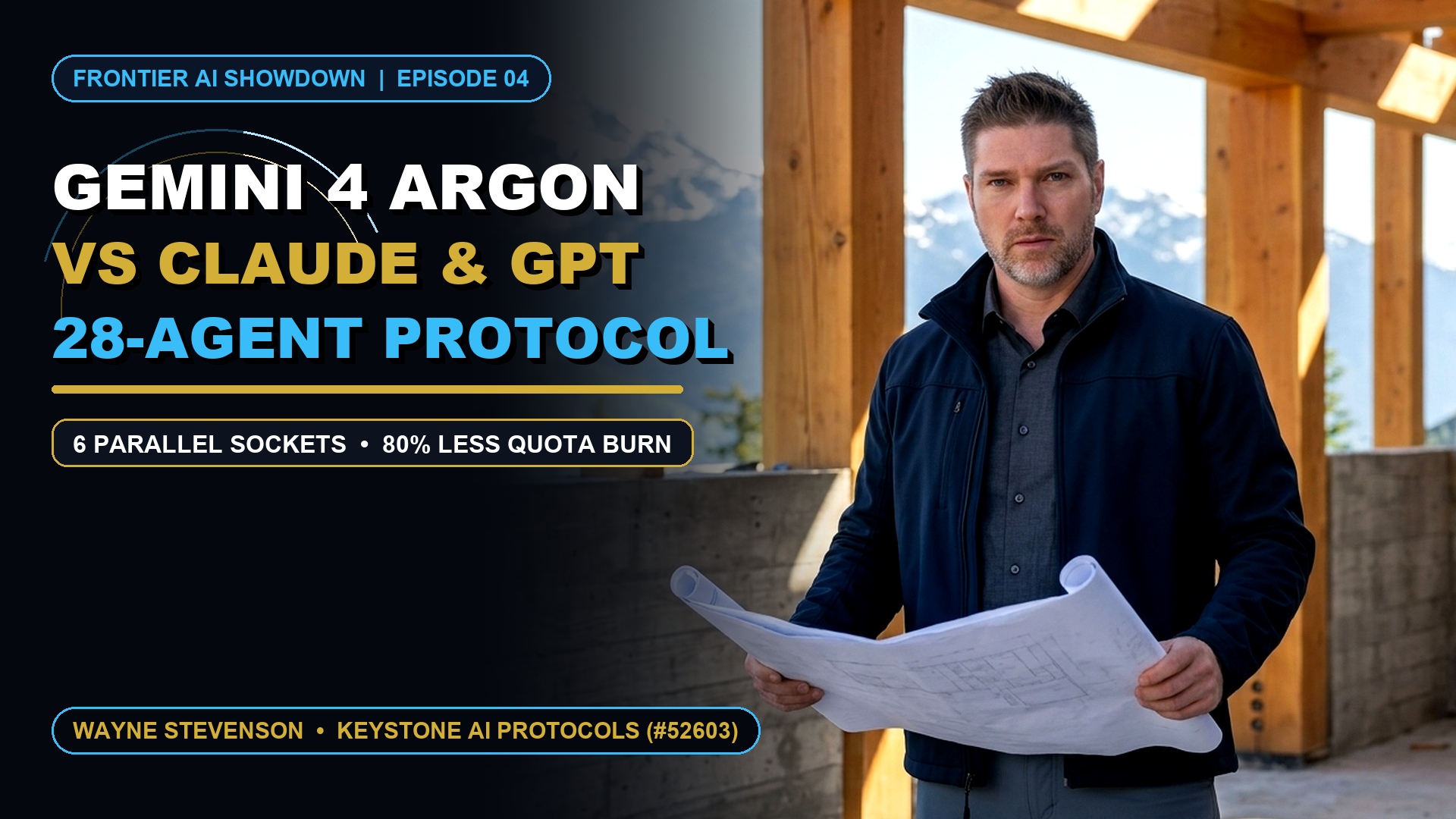
To deliver high-density autonomous AI systems breakdowns and interactive 3D holographic telemetry while managing active construction and engineering operations across British Columbia, this briefing utilizes Wayne Stevenson’s photorealistic AI digital twin.
Watch the 40-Second Vertical Briefing (Gemini 4 Argon Autonomous AI Protocol #Shorts)
Includes Turnkey FastMCP Contract Templates, 1-Click Workstation Installer & Full Multi-Agent Video Walkthroughs