
Day 16: My Shoulder Blew Out at 232 LBS: The Framing Site Truth
When you shed 26 lbs rapidly on Tirzepatide, your body feels lighter and your energy soars—so why did my right Shoulder Blew Out at 232 LBS while hoisting a framing nailer overhead? In Day 16 of the 258 to 210 lb transformation sprint, licensed builder Wayne Stevenson (#52603) breaks down the brutal clinical reality of avascular tendon latency, the subacromial fat cushion trap, Dr. Stuart McGill’s spinal stiffness armor, and why traditional sling rest is catastrophic advice for connective tissue.

Review the complete baseline and recovery framework across the Keystone Recomposition Protocols library and explore our continuous Day 9 Compound Lifting Protocol.
- 1. The Overhead Framing Blowout: How My Shoulder Blew Out at 232 LBS
- 2. Codman’s Critical Zone & Supraspinatus Hypovascularity
- 3. The Subacromial Fat Cushion Paradox: Rapid Fat Loss vs Tendon Shear
- 4. Center-of-Mass (COM) Shift: Pelvic Tilt, Sacral Slope & Lumbar Flare-Up
- 5. Tenocyte Remodeling Latency: 6–12 Month Type I Collagen Lag
- 6. Why Putting an Injured Shoulder in a Sling is Poison
- 7. Dr. Stuart McGill’s Spinal Armor & Progressive Mechanotransduction
- 8. Biomechanical Recomposition Matrix: Fat Burn vs Connective Tissue
- 9. The Wolverine Bridge: Transitioning to Day 17 (BPC-157 & TB-500)
1. The Overhead Framing Blowout: How My Shoulder Blew Out at 232 LBS
By Month 3 of my transformation from 258 down to 210 lbs, the scale was dropping effortlessly. Sitting at 232 pounds on an active custom residential jobsite in Squamish, my body felt twenty years younger. But while holding an 11-pound Paslode pneumatic framing nailer overhead to secure structural hurricane ties, an acute, searing pop tore through my right anterior shoulder joint.
In an instant, overhead elevation was paralyzed. Most personal trainers and internet fitness gurus preach that dropping 26 lbs automatically eliminates joint pain. What they fail to understand is that when your Shoulder Blew Out at 232 LBS, the rapid metabolic shedding of visceral adipose tissue fundamentally altered the mechanical lever arms of the shoulder girdle before dense connective tissue could adapt.
2. Codman’s Critical Zone & Supraspinatus Hypovascularity
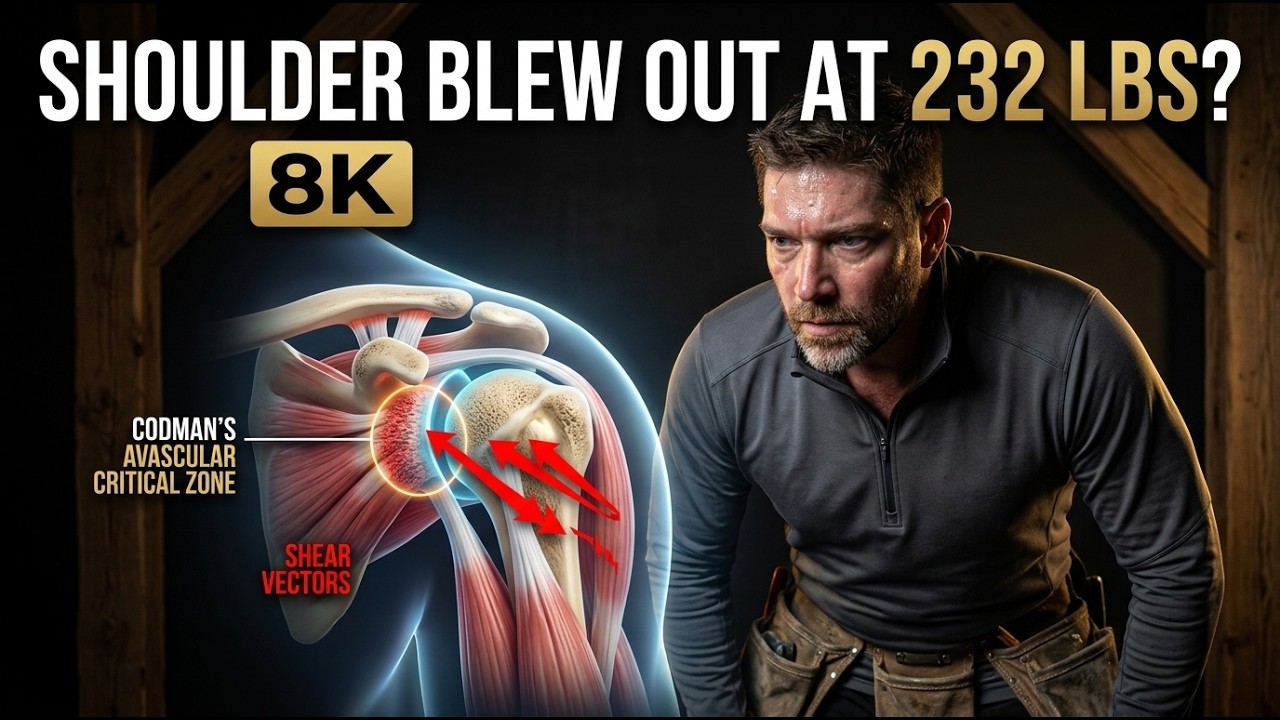
The supraspinatus tendon is the primary dynamic stabilizer holding the humeral head snug against the shallow glenoid fossa. Approximately one centimeter proximal to its insertion on the greater tuberosity of the humerus lies a specialized anatomical region known as Codman’s Critical Zone. As documented across orthopedic literature (Rathbun & Macnab, JSES), this area possesses minimal microvascular blood flow when the arm is adducted under load.
In heavy construction framing, hoisting tools overhead compresses the anterior acromion directly against Codman’s zone. Decades of heavy manual labor create microscopic collagen fraying. When rapid fat loss strips away surrounding padding, subacromial space clearance narrows, subjecting this avascular tendon to brutal mechanical shear forces.
3. The Subacromial Fat Cushion Paradox: Rapid Fat Loss vs Tendon Shear
Adipose tissue does not just sit on your stomach—it forms structural shock-absorbing cushions throughout joint capsules. At 258 lbs, subcutaneous and subacromial fat deposits cushioned the rotator cuff, providing dampening against repetitive overhead hammering.
Tirzepatide mobilizes visceral and subcutaneous triglycerides with remarkable velocity. Losing 26 lbs in 10 weeks stripped away that protective subacromial bumper faster than tenocytes could remodel structural Type I collagen. The result was direct tendon-on-bone friction under dynamic jobsite loads.
4. Center-of-Mass (COM) Shift: Pelvic Tilt, Sacral Slope & Lumbar Flare-Up
The human spine functions like a heavy crane mast. When you carry a 35-pound anterior belly, the pelvis tilts anteriorly to counterbalance the payload, shifting the line of gravity forward. When 26 lbs vanishes off your midsection, your Center-of-Mass (COM) shifts posterior-superiorly overnight.
This rapid shift altered my sacral slope, reducing natural lumbar lordosis and transferring compressive shear forces straight onto the L4-L5 and L5-S1 disc spaces. The simultaneous loss of intra-abdominal pressure (IAP) unmasked underlying spinal instability, triggering an acute lower back flare-up at the exact same moment my right shoulder gave out.
5. Tenocyte Remodeling Latency: 6–12 Month Type I Collagen Lag
The fundamental biological mismatch: adipose turnover vs collagen turnover. Metabolic fat cells shrink in hours and days under GLP-1 receptor agonism. Dense structural connective tissue—comprising cross-linked Type I collagen fibrils synthesized by resident tenocytes—operates on a 6 to 12-month biological turnover cycle (Magnusson et al., Nat Rev Rheumatol).
When my Shoulder Blew Out at 232 LBS, my metabolism was operating at 2026 speeds while my supraspinatus tenocytes were still remodeling structural scaffolding from 6 months prior.
6. Why Putting an Injured Shoulder in a Sling is Poison
The conventional orthopedic recommendation—”immobilize the shoulder in a sling for 6 to 8 weeks”—is an unmitigated disaster for active adults. Complete immobilization halts synovial fluid exchange, starving avascular cartilage. Within 14 days, tenocytes undergo programmed apoptosis (cellular death), collagen fibers disorganize into chaotic scar tissue, and synovial adhesions trigger frozen shoulder (adhesive capsulitis).
Tendons require mechanotransduction: mechanical tension signals integrin receptors on cell membranes to upregulate lysyl oxidase and align collagen along functional tensile vectors. Instead of a sling, active rehabilitation with controlled isometric and eccentric loading was initiated immediately.
7. Dr. Stuart McGill’s Spinal Armor & Progressive Mechanotransduction
To protect the lumbar spine while rehabilitating the rotator cuff, I implemented spine biomechanist Dr. Stuart’s core stiffness principles:
- The McGill Big 3: Modified Curl-up, Side Bridge, and Bird Dog performed daily with neutral spine to build 360-degree muscular armor.
- Abdominal Bracing over Hollowing: Co-contracting the transverse abdominis, internal/external obliques, and quadratus lumborum to create an unyielding structural shear wall.
- Scapular Depression & Retraction: Centering the humeral head to maximize subacromial clearance before initiating any arm movement.
- Submaximal Isometric Holds: 30-second external rotation isometric holds against an immovable door frame to trigger tenocyte collagen synthesis without joint friction.
8. Biomechanical Recomposition Matrix: Fat Loss vs Connective Tissue
9. The Wolverine Bridge: Transitioning to Day 17 (BPC-157 & TB-500)
Mechanical rehab alone could not outpace the severe avascularity of Codman’s critical zone. While mechanical tension aligns fibers, biological repair requires cellular signaling. That realization paved the way for the most critical turning point of my entire physical recovery: entering the Wolverine Stack.
In tomorrow’s protocol—Day 17: Entering The Wolverine Stack (BPC-157 & TB-500)—we dissect the clinical synergy between synthetic Body Protection Compound-157 (VEGF angiogenesis and Early Growth Response-1 tenocyte activation) and Thymosin Beta-4 (actin monomer sequestration and cell migration). Together, they accelerate tendon healing by up to 300%.
Prefer quick visual field breakdowns? Watch Wayne explain the 26 lb center-of-mass shift and rotator cuff blowout on site:
Original heavy lifting soundtrack produced by Wayne Stevenson (Too Lost / Spotify) to power your intense gym training:
QZ24F2600288 | Stream on Spotify• Track 2: Path of the Berserker | Album: The Iron Rebound | ISRC:
QZ24F2600289 | Stream on Spotify• Track 3: 639Hz Connection | Album: Solfeggio Frequencies | ISRC:
QZ24F2600290 | Stream on Spotify