
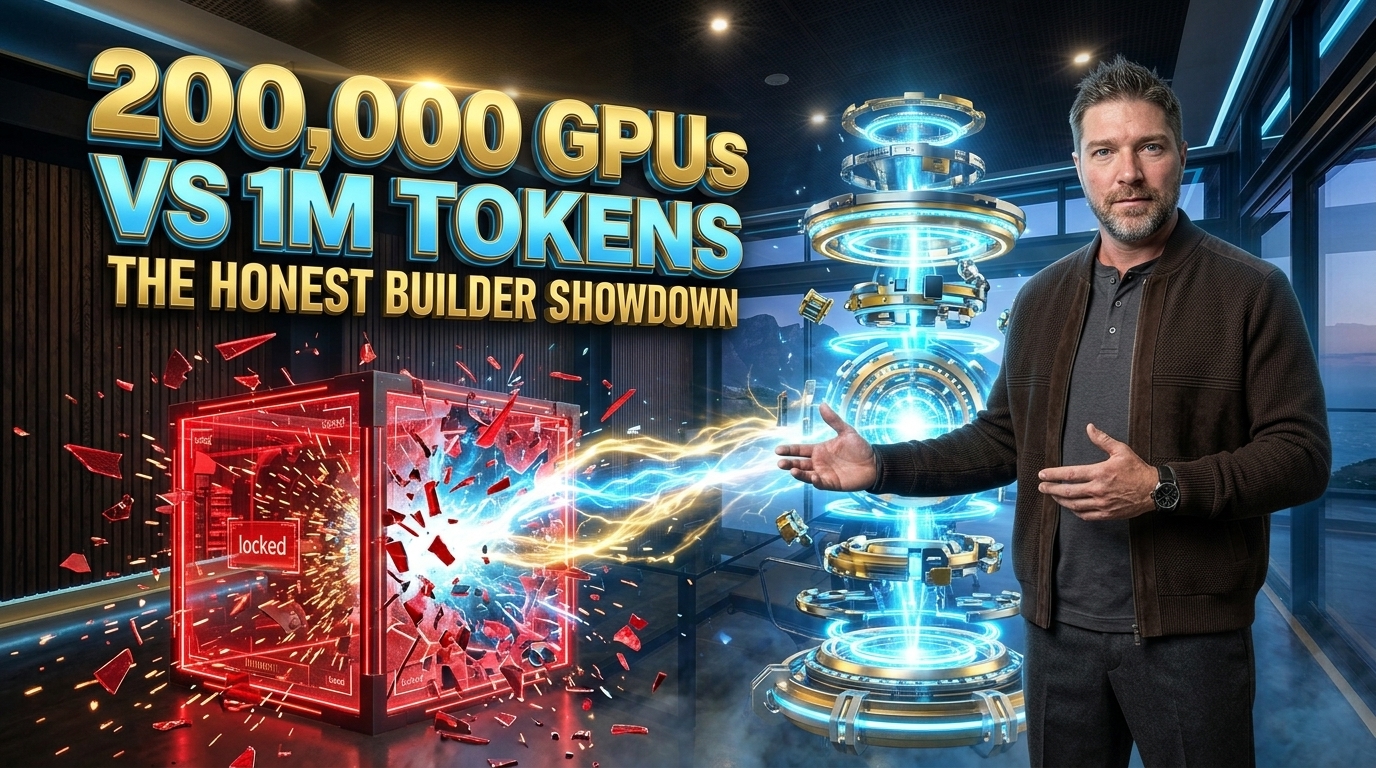
From my studio workstation in British Columbia—where I split my day between running active custom residential and multiplex sites at Keystone Possibilities Ltd. (BC Housing Licensed Builder #52603) and orchestrating our 28-agent software swarm—I judge frontier models by whether they drive real operating-system tools without friction.
Grok 3 vs Gemini is the debate dominating every engineering feed right now—yet once OpenAI o3 and Anthropic Claude 3.7 Sonnet enter my daily build harness, isolated leaderboard trophies stop telling the whole story. Every time a frontier lab posts a two-point jump on a solo math or single-ticket coding chart, I watch founders rip apart working pipelines to chase a model they have never stress-tested across cooperating agents.
Managing physical framing crews by day and autonomous code builds by night gives me a much stricter filter for Grok 3 vs Gemini. On an active job site, a gleaming specialty wrench that refuses to fit our standard eighteen-volt cordless battery platform stays in the trailer because tool friction stalls the entire deck. Production software works the exact same way: throughput comes from how cleanly a model connects to local filesystems, live browser ports, multi-repository memory, and desktop media binaries.
Table of Contents
1. Honest Builder Credit: Where Rival Frontier Labs Excel on Solo Prompts
Before I critique any architectural bottleneck, I give rival labs full credit where their raw engineering shines. When an engineer opens a single chat tab and submits one self-contained puzzle, three competing platforms post genuine breakthroughs.
At xAI, the 200,000-GPU Memphis Colossus supercluster drives Grok 3 past 1402 Elo on Chatbot Arena alongside 93% accuracy on AIME math, 85% on GPQA science, and 80% on LiveCodeBench. OpenAI o3 scales test-time search past 96% on AIME theorems, while Anthropic’s Claude 3.7 Sonnet pairs hybrid thinking with Claude Code to clear 70.3% on single-repository SWE-bench Verified tickets. Every one of those scores, however, measures an isolated model answering a solo prompt—not twenty-eight concurrent agents sharing live workstation state.
2. Grok 3 vs Gemini Under Swarm Load: Four Walls That Stall Closed Clouds
Why do I keep OpenAI and Grok out of our core production studio despite those solo numbers? Because the moment I test Grok 3 vs Gemini across cooperating agents that must build, audit, and ship real software together, closed ecosystems hit four structural walls:
- Walled-Garden Cloud Sandboxes: Hosted cloud containers resist direct local control the instant an agent needs authenticated Chrome sessions, desktop compilers, or studio audio hardware on my machine.
- 200k Ceilings & Reasoning Fee Spikes: Passing full syntax trees across agent waves burns through a 200,000-token cap in a few turns while hidden reasoning tokens multiply invoices—like dumping two-by-four offcuts across an active framing subfloor until carpenters trip over their own lumber.
- Brittle Stitched Wrappers: Gluing separate speech, vision, and text endpoints together adds network lag joints where one schema hiccup drops an active handoff.
- Parallel HTTP 429 Choke Points: Firing four to eight specialist subagents concurrently triggers aggressive rate-limit throttling built for solo browser typing.
3. Grok 3 vs Gemini Matrix: Why Google Antigravity Works With Whatever
In my daily workflow, Grok 3 vs Gemini comes down to universal job-site compatibility. Inside Google Antigravity, Gemini runs like that shared eighteen-volt cordless battery platform across saws, rotary hammers, and floodlights. A one-million to two-million-token native window backed by up to 95% Gemini Context Caching discounts keeps entire multi-language repositories warm in memory for pennies.
Beneath the weights, open Model Context Protocol (FastMCP) typed contracts wire Gemini straight into local OS processes, SQLite vector memory, and background services over sub-5ms loopback sockets. My agents verify live DOM state on Chrome DevTools Protocol Port 9222, assemble 4K masters inside DaVinci Resolve Studio via native Lua bridges, and fuse code, audio, video, and PDFs in single multimodal passes.
| System Layer | Grok 3 (200k Colossus) | OpenAI o3 & Claude 3.7 | Gemini + Google Antigravity |
|---|---|---|---|
| Primary Strength | 1402+ Elo • dense GPU search | Solo math proofs & single Git tickets | End-to-end 28-agent swarm execution |
| Context & Economics | Chat-first window • heavy cluster draw | 200k cap • steep hidden thinking burn | 1M–2M window • up to 95% cache discount |
| OS & Browser Control | External wrapper glue required | Remote VM or screenshot-loop friction | Native FastMCP + Chrome CDP Port 9222 |
| Builder Verdict | Elite raw data-center horsepower | Strong isolated puzzle specialists | Universal 18V Bus — Works With Whatever |
4. Inside My 8-Minute 4K Briefing: Four Acts & Daily 28-Agent Routing
Filmed inside our dark fluted oak and titanium twilight boardroom, my eight-and-a-half-minute 4K briefing unpacks Grok 3 vs Gemini across four architectural acts:
- Act I (0:00–2:00) — Frontier Leaderboard Reality Check: How I separate genuine single-prompt lab milestones from social-media hype.
- Act II (2:00–4:00) — Job-Site Physics vs. Closed Cloud Cages: Why proprietary sandboxes and narrow context ceilings break down once multiple specialists pass full repositories back and forth.
- Act III (4:00–6:00) — Universal Interoperability in Action: Pairing cached million-token blueprints with open local tool sockets, live browser verification, and automated timeline scripting.
- Act IV (6:00–8:30) — Live 28-Agent Topology & Sovereign Air-Gap: Inside my daily split: four Tier A Flash scouts handle sub-second symbol searches and web verification, twenty-four Tier B inherit-mode specialists execute full-stack builds and adversarial audits, and two detached local services run zero-rent GPU Faster-Whisper F9 voice capture plus optical S/PDIF monitor keep-alive—auditing BC Bill 44 multiplex bylaws in the morning and compiling desktop software by afternoon while keeping our underlying service code air-gapped.
5. 40-Second Vertical Briefing (9:16 Short) & Sovereign Builder Takeaway
Sending this Grok 3 vs Gemini builder breakdown to a technical co-founder on mobile? Watch my forty-second vertical companion briefing below:
My rule as both a licensed builder and a systems architect stays simple: respect raw GPU clusters and academic math scores, but never lock your intellectual property inside a closed corporate cage. Settle Grok 3 vs Gemini by building on open tool contracts and universal operating-system compatibility at keystonerecomposition.com, and every frontier leap compounds your workstation overnight.
Original 24-bit studio masters produced by Wayne Stevenson and mixed at -18.0 dB beneath this 4K architectural briefing.
Written by Wayne Stevenson (BC Housing Licensed Builder #52603, featuring my digital studio avatar on video while I manage active British Columbia construction and engineering operations). Internal service implementations and orchestration prompts remain air-gapped inside our private vault.
Related Keystone Engineering Briefings

Wayne Stevenson
Wayne Stevenson — Licensed BC Builder #52603, Electronic Music Producer & Autonomous AI Systems Architect
Evidence-based systems, functional sonic architecture, and autonomous multi-agent engineering for high-performance fitness, longevity, and mountain lifestyle design.